
How to navigate a changing media landscape and find your voice among the noise
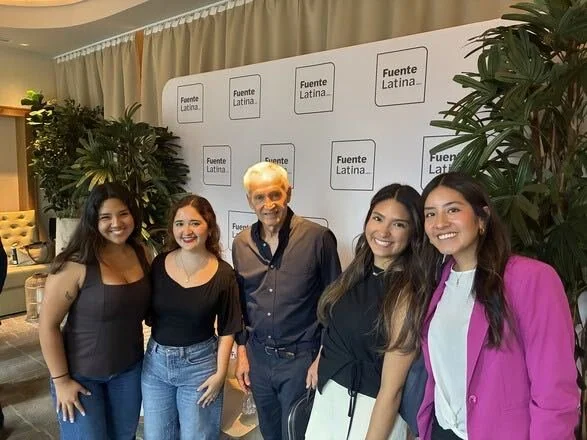
Long Beach Current editor-in-chief Angela Osorio and fellow student journalists met longtime TV reporter and now independent journalist Jorge Ramos at the Fuente Latina conference in Miami.
The first thing legendary TV broadcaster Jorge Ramos told a group of student journalists was that he was a dinosaur.
Not because he was almost 70 years old, or because his hair was snowy-white, but because the long-standing platform, the TV news that every Latino grew up watching him on was fading away.
I spent the weekend of Sept. 25-26 hearing from a diverse group of Latino journalists and industry professionals at the Fuente Latina Student Summit, from now-independent journalist Ramos to TikTok-famous independent journalist Benjamin Zamora.
They all echoed a similar sentiment: We are navigating one of the most challenging moments our industry has faced – one that has turned away from traditional, centuries-old markets.
We no longer rush to the TV to watch breaking news. We no longer read the newspaper delivered to our doorstep every morning.
In the era of AI, doomscrolling and ever-shortening attention spans, we are forced to turn to other strategies, formats and platforms to reach new audiences.
But this isn't a reason to panic. Though the industry looks bleak – and has certainly had me wondering whether it was time to pivot to a different career – this is not a call for help. It’s an opportunity to reach new audiences, to communicate the same message to diverse and niche audiences.
Though our platforms and consumption methods may change, our journalism remains the same. It’s only a matter of adapting to the changing media landscape and meeting our audiences where they’re at.
Here are three lessons I learned from journalists I admire.
1. Be authentic. Don’t follow the crowd.
The last thing we want to do is add to the noise and sea of voices online. As independent journalists, our goal isn’t to be the quickest, to get the news out first or to repeat what other outlets have reported.
Our goal is to find something only we can report on.
It could be the neighborhood you grew up in, the food you love eating, your cultural background – you name it. Our upbringing, backgrounds, knowledge, connections and expertise offer us a special credibility that no money can buy.
It’s why we go to Handel’s for ice cream or In-N-Out for cheeseburgers – once a brand gains a reputation for the object or service it provides, it becomes a staple, a go-to, a trusted source.
Find an angle that no one else is covering – and claim it proudly as your beat. Get the interview only you could do, and tell the story only you could report on.
Find what it is that drives and motivates you. What could make you talk for hours
And become that trusted source for your viewers.
2. AI will never replace journalism. Here’s why.
Ramos told us he isn’t scared of AI – and we shouldn’t be, either.
AI can give you the information you want, but it’s journalists who provide the context viewers need.
It’s human journalists who can connect with people and learn their stories, telling them with the sensitivity and nuance that only humans can provide.
It’s human journalists who digest the information overload and make sense of it, applying their background, knowledge and experiences to their storytelling to help us understand the world better.
That, at least to Ramos, will never go away.
3. Consistency is key.
Benjamin Zamora started his platform when he was still working for a Telemundo station in Las Vegas. He began posting Spanish news videos on TikTok during the pandemic, back when no one else was doing it.
Seeing a future in TikTok, Zamora filmed several videos a day and posted consistently.
His following eventually skyrocketed. At one point, through TikTok monetization, he was making a year’s salary at Telemundo in just a few months.
Today, with over 6 million followers on TikTok, he continues to cover breaking news and trending stories for his Spanish-speaking audience.
He’s covered presidential elections in Mexico and El Salvador, as well as White House events, climate summits and more.
All from his iPhone.
Zamora is proof that if you see potential in a platform, a need for a specific type of content, an audience that is hungry for what you can provide – take advantage of it.
Challenge yourself and try something new.
And when you do, stay consistent – you might be surprised with how it will pay off.
Angela Osorio is the 2026-27 editor-in-chief of CSULB’s student-run newspaper, the Long Beach Current. Within the past year, she has interned at ABC7 on the digital news team, at Los Angeles Times as a food reporter, and at the Signal Tribune in Long Beach as an environmental reporter. She also traveled to Israel to report for Fuente Latina, a non-profit that provides journalists with resources to cover news in the Middle East. Osorio aspires to work as a metro reporter at a national or regional publication after graduation.